Showing posts with label sex. Show all posts

The Laughing Dead (1989) What's So Funny About (Priest's Love And Aztec Resurrection)

I've seen movies with zombies. I've seen movies with mad scientists. I've seen movies with Priests that have lost their path. I've even seen movies where the Aztec people attempt to resurrect their culture. And I have seen plenty of movies where students on a field trip get menaced by any number of things. What I had never seen was a climax that boiled down to a basketball game that turns into a Ray Harryhausen style monster brawl, but that's just what The Laughing Dead delivered. Perhaps that's what happens when you get a Thai-American avant garde composer, poet,  and science fiction and horror novelist in the director's chair. Billed under a shortened version of his full name, Somtow Sucharitkul, in literary circles he would be known better as author S.P. Somtow. The first time director, writer, and star fashioned am intriguingly cheesy vision that both captured the flavor of early 80s horror fiction and the spirit of the cheapo horror feature. So come with me and let's have a few chuckles with The Laughing Dead.

The Wicker Tree (2010) Now Available In Pier 1’s Everywhere

The October horror train keeps on rolling, and it’s come to a stop in belated sequel city. I’m not sure there has been a sequel to any film that had a delay of thirty seven years between the first and second film releases, but I know Robin Hardy has just been way, way too busy to climb back in the director’s chair. After 1973’s The Wicker Man, a classic cult horror film that really delves into a different area of horror than most film, Robin waited thirteen years before directing his next feature The Fantasist. Then he… well, frankly I don’t know what Mr. Hardy has been puttering around doing for the last 23 years, but it had something to do with writing a spiritual sequel to The Wicker Man in the form of a novel, the 2006 release Cowboys for Christ. When I first hear rumor of today’s film, it was in production under the same name as the title, and the brief synopsis involving Texan evangelicals getting mixed up with Scottish pagans was enough to pique my interest. However, when the film arrived under the sequelish name The Wicker Tree, my interest waned. The title, perhaps foisted on him to secure financing (or perhaps of his own decision, I could never find a clear answer) took all the punch out of the film making it look like a wan grab for cash by reusing the ‘Wicker’ name, and after Nic Cage had gotten done with it, that hardly even seems like the best plan. Never the less, I decided to check back into the world previously dominated by Lord Summerisle, who does make an appearance here linking the two films, and see if The Wicker Tree made me want to scream “Oh, Jesus. Oh, God Noooooooo!” or if I’d just rather watch dudes in bear costumes beating up chicks

Friday the 13th: A New Beginning (1985) See Me, Feel Me, Touch Me, Kill Me, Tommy

After only two installments of the Halloween franchise, they tried to leave Michael Myers by the wayside with the maligned entry in the series Halloween III: Season of the Witch. While I love III (and if you haven’t seen the new edition put out by Shout! Factory you’re missing out on the best version of the film out there), the masses in general demanded their Shape, and sure enough six years later the franchise was born again in Halloween IV: The Return of Michael Myers. However, the man in the Shatner mask was not the only slasher whose franchise tried to leave him behind. Such was also the case in today’s film, Friday the 13th: A New Beginning. Eschewing a numerical mark on this entry in the series, A New Beginning tries to become a jumping off point to leave the mythos of Mrs. Voorhees, Baghead Jason, and the hockey mask in the dust thanks to the murderous hands of Corey Feldman in Friday the 13th IV: The Final Chapter. We all know how well that worked out. However, director Danny Steinmann, who also wrote the film, crafted a tale which is deeply flawed, but it also manages to draw from the well from which so many slashers spring, the Italian giallo. So join me for this trip to slasher country where A New Beginning slowly and surely gives way to a new life for Jason Voorhees.

The Irrepressible Miss Stanwyck: The Strange Love of Martha Ivers (1946)

Welcome back to week two of The Irrepressible Miss Stanwyck, my month long tribute to one of my favorite leading ladies. Last week, I looked at Jeopardy!, a film which saw Barbara going all the way to save her dying husband. While it showed off her ability to deliver hard edged, risky performances, it is a role tempered with tenderness. This week, despite the title that both hints to amorous adventures and sounds like a lost gialli, tenderness is secondary to self preservation as Stanwyck shows off her tough side in The Strange Love of Martha Ivers. Along with Barbara, Strange Love is the first film role from an icon of cinema, Kirk Douglas, and it also marks her first collaboration Van Heflin, who would co-star with her twice more. The trio, along with blonde bombshell Lizabeth Scott, gets mixed up in a tale of murder, blackmail, and revenge coloring Film Noir with shades of grey.

The Hot Spot (1990): Is Located Between Jennifer Connelly and Virginia Madsen

The scorching heat of summer is truly upon us. Yesterday, here at The Lair, it reached 106 degrees, and there’s no relief in sight. However, I must count my blessings. I generally get to stay in the confines of an air conditioned area, I don’t live somewhere crazy, stupid hot like Texas, and I’m not caught in a love triangle between Jennifer Connelly and Virginia Madsen. Wait, scratch that last one. No matter the external temperature, a situation like that would surely heat me up. Though when you’re Don Johnson, riding high on the star power garnered from six seasons of the pastel hued Miami Vice, you can afford to act blasé about two of the hottest women to ever grace the screen vying for your affections. While the onscreen sexy time is only one portion of today’s film, The Hot Spot, it definitely heats up a cool noir story from director Dennis Hopper. 

The Lonely Violent Beach (1971): Bikers, Beaches, and Not So Bloody Revenge

If you laid out brochures for a number of vacation destinations, many people would choose to go to Sandals or Atlantis. Some might pick an iconic locale like Muscle Beach or head off to Atlantic Beach for some gambling, and Bikini Beach Resort in Panama City, Florida might tempt a number of folks. The one brochure that would never be touched is for The Lonely Violent Beach. No matter how stunning the photographs of waves on the beach might be or how many assurances there were about the area being devoid of roving biker gangs, people simply wouldn’t want to go. There could be pictures of beautiful sunsets and wide open, deserted stretches of beach laid out under a legend claiming less rape this year than ever before, and I just don’t think anyone would be convinced. Unless, I suppose, you were a member of a roving, raping biker gang who didn’t buy into the hype.

Get Off on the Goldfoot: Kicking off Summer with Vincent Price

While the calendar might denote a specific day that summer begins astrologically, I think most of us will agree that when June arrives, summer is upon us. Here at the Lair, it’s no different. It’s the time of year I break out the Bermuda shorts, drag out the lawn chair, slather up with coconut oil, and start soaking in the rays. It also means that my heart turns to the lighter side of genre fare. From the blood soaked beaches to the dense tropic jungles, you’ll find me turning up the heat all summer long. To start it off, I wanted to bring in the king of cool in a pair of sizzling films. When you think about beaches, surf, and sand, the name Vincent Price surely springs to mind right away. Well, perhaps not right away, but I think today I can bring it  a little closer with two films featuring Price commanding a phalanx of two pieces.

Mental Health Awareness Month: Hour of the Wolf (1968)

When Ryne from The Moon is a Dead World asked for folks to participate in Viewer Vomit for this month, I had no idea what movie he was going to choose. In a stroke of good fortune, well, fortune, he picked Ingmar Bergman’s 1968 film Hour of the Wolf. It’s honestly not a movie I would pick to watch on my own, but the themes of madness fit perfectly into Mental Health Awareness Month. My knowledge of Ingmar Bergman begins and ends with The Seventh Seal, and I hadn't watched that in over 20 years. And, yes, before you do the math, that means I watched it to try and get more out of Bill and Ted’s Bogus Journey. So I won’t claim or act like I’m an expert on the Swedish director or this type of art house fare. Frankly, it’s not really to my taste, but from what I‘ve read, Hour of the Wolf is the closest Bergman ever got to making a horror film. (I suppose chess playing with an embodiment of Death doesn’t count.) There’s no doubt that there is a lot of horrific ideals to be found in Hour of the Wolf, but there was a different kind of terror in store for me.

Hey Girl. Hauer You Doin’?: Spetters (1980)

It’s Wednesday, and that means another edition of the hunkiest feature ever to grace the Lair, Hey Girl. Hauer You Doin’? This time we get into the way back machine with Rutger (and his pal Paul Verhoeven) for their breakthrough film, Spetters. This is a film that’s got everything, drama, violence, sports, comedy, tragedy, and a surprising amount of full frontal male nudity. If that doesn’t get you intrigued, then how about this. Remember ’Hunks’. People used to say that, and not just on TV or in movies, I was there. I heard it. Not to sound like Andy Rooney, but when did that stop? At any rate, imagine my delight when I found out that Spetters roughly translated means hunks. While the idea behind the title might make images of super buff dudes oiled up around a pool,  the Dutch had another idea in mind. These hunks invoked images of another tormented group of teen boys, The Outsiders. So if you’ve ever wanted a teen drama with 100% more wooden shoes than you’ve ever seen in a film, then rev up your engines cause this if for you.

You Don't Know Shat !?! : Secrets of a Married Man (1984)

Over the last few weeks of the Shatner celebration, we've seen the Shat as a crusading father rescuing his daughter from gang life in Broken Angel and talking turkey about the birds and the bees is The Explosive Generation. This week finds Shatner on the other side of the ethical coin as a cad gone mad in Secrets of a Married Man. This made for TV film feels like prehistoric version of a Lifetime offering, but spun on it's head in a fever of Iron John induced melodrama. It becomes a tale of middle class male ennui where Shatner, playing for sympathy, comes up well short. Secrets of a Married Man  is a slice of of 80s yuppsterism that shows off just how flawed the free love generation became as they moved into the self centered, costumer driven decade. Plus, you get to see Captain Kirk picking up hookers on the corner.

Lips of Blood (1975): The Blood Keeps on Rollin(g)

Over the course of a film career that spanned almost fifty years, French auteur Jean Rollin made no less than six films with the word 'Vampire' in the title. That's not even counting how many others, like today's film, concerned bloodsuckers. However this month is all about the life giving liquid, and Rollin only made one film with that substance in the title, 1975's Levres de sang a.k.a Lips of Blood. Surprisingly, while I know of Rollin by reputation, this is the first time I've seen one of his films. I'm not sure what I expected. I had heard that Rollin marries the words of the French New Wave, erotica, and horror in equal, though often baffling, proportions. I also knew that Lips of Blood was released stateside in a X Rated format under the title Suck Me, Vampire, which is certainly a direct title but doesn't lead one to wax poetic about the erotic. Thankfully, the version I watched was the French cut, and while it still carried plenty of full frontal female nudity, it also detailed a story about childhood innocence all wrapped up in a surrealist's vision of vampires.

While attending a party for a perfume company. Frederic (Jean-Loup Philippe) spots the new advertising poster for the fragrance. In it, a picture of a ruined castle makes him flash back to lost memories of his childhood. As a young boy, he got lost in the castle meeting up with a teenage girl who protected him through the night before sending him back to his mother. In his innocent 12 year old way, Frederic fell in love with the young girl who he never saw again. Now, twenty years later and spurred on by the appearance of the picture, Frederic desires to find the castle again. His mother denies they were ever there, and mysterious people begin to follow him trying to keep him away from the truth. Meanwhile, Frederic releases four nubile young vampires from their coffins and they act as his protectors. The young girl, Jennifer (Annie Belle) begins to appear to him in visions, and as he draws closer to finding her, he discovers that his own family has hidden a secret of vampirism in the past.

Delicately filmed, Lips of Blood definitely speaks to the French New Wave with interesting visuals and a surrealist quality layered into the impressionistic story. It also brought my mind back to the films of George Melies with a still, silent film quality. While on the surface Rollin has made a erotic vampire tale, the irony of that is that the film is more about the lost innocence of childhood. When Frederic was a child, he fell in love with a vampire, a young girl shunned from the community, without a second thought. As an adult, he longed to recapture the innocence of youth. Because of the family secret, his mother wishes to deny her son his childhood, but eventually he finds he way back to the innocence. The end of the film finds him literally stripped of the trappings of modern life, and his plans from there include a fantastic, imaginative future that seems to hard to believe, at least from the view of an adult. To a child, it would seem like a blissful utopia. Rollin once said, "My childhood was wonderful, and my reflections of it are very romantic, sweet and utterly transfigured. Like recalling one's first love, 20 years later." This leads me to believe that Lips of Blood is an extremely personal film with Rollin looking back with misty eyes on his youth.

Jean-Loup Philippe, who stars as Frederic, co-wrote Lips of Blood with Jean Rollin, and it would become Jean-Loup's first leading role and most recognizable part. The actor gives a stunning performance that sees him shed layers of emotion as his character's revelations erupt. Annie Belle, best known among horror fans as Lisa in House on the Edge of the Park, oozes a strange,androgynous sexuality that doesn't seem crude or salacious. Through she has only a small number of scenes, Natalie Perrey makes a large impression on the film as Frederic's mother. It's also interesting to look into her career. While she appeared in a large number of films as an actress, her largest amount of film work came as a script supervisor. Over the course of her career, she would also do editing, direct, work in the production department, write two films, and even work on costumes in one. It's fascinating to see someone whose life revolved around film and have such a wildly varied career.

While Lips of Blood was my first film by Jean Rollin, it certainly won't be the last. Like a more artistically minded version of Jess Franco, Rollin filled this film with erotic visions but without an indelicate overtone. Rollin's film also turns the vampire myth on its ear. While some characters have reason to fear the vampires, Frederic does not. He sees something innocent in his first love even if she is a bloodsucking ghoul. Lips of Blood was a beautiful looking film with big ideas being talked about, and it stays away from horror cliche while firmly pulling from the genre's core. That about wraps it up for today's entry in Blood Donation Month. I hope everyone is enjoying my exploration of these bloody films, and I'll see you back here in a day or two for another film about the Roy Hud (blame the cockney rhyming slang dictionary for that one).

Bugg Rating

The Deadly Doll/ LBL Thanksgiving Swap Has Been a Baaaaad Boy (Bubby)

It’s been a couple of months since last Emily of the Deadly Doll’s House of Horror Nonsense and I got a chance to do a film swap, but after our recent meet up at Horrorhound Weekend, I really wanted to get back to our film exchange. After swapping around a few ideas, we settled on a Thanksgiving-ish theme, "Movies We Are Thankful For". For my part, I gave her Alice’s Restaurant, Arthur Penn’s 1969 adaptation of Arlo Guthrie’s eighteen and a half minute song featuring hippy Thanksgiving, courtroom hijinx, and a rousing lesson in draft dodging. Click on over to Deadly Doll’s to see why Alice’s makes me thankful, and what Emily thought about it, but first Emily's pick, Bad Boy Bubby, an Australian movie that's perfect for the whole family at the holidays. It has to be family friendly. Well, that is if your family is really into incest or torturing the family cat. I'm getting ahead of myself. Let me give Emily a chance to set up her thankful selection...

"I can't officially argue that Bad Boy Bubby is an appropriate Thanksgiving movie--for starters, it takes place in Australia, where turkey is probably replaced with emu for all I know--but it's certainly a film that I'm THANKFUL for. It's cheating of course, but still: this 1993 independent black comedy is one of those movies that just make me happy to WATCH MOVIES, and thankful that there will always be artists who can take chances onscreen.

So sure, there's incest, animal violence, sexual harassment, and surprisingly grisly murder, but somehow all of these acts work in harmony to create a weirdly sweet coming of age tale not just about a boy growing up, but about a man discovering the world and all of its gifts. Pizza! Cats! Love! Duct Tape! Aren’t we all thankful these things exist? Set it to a bizarro spoken-word-rock score and bam! We’ve got something that celebrates the essence of this fine and tasty holiday far more appropriately than giant balloon animals."

To say that Bad Bob Bubby doesn’t start off as your typical Turkey Day affair is possibly the greatest understatement since the settlers told the Indians that those blankets looked fine to them. The first thirty minutes of the film are some of the most excruciating cinema I’ve ever managed to watch. I would have had an easier time watching Salo, Cannibal Holocaust, and Martyrs on three screens simultaneously.  Thirty five year old Bubby (Nicolas Hope) has never set foot outside the walls of the dingy apartment he calls home. His domineering mother (Claire Benito) beats him, molests him, and threatens him with poison air and a vengeful God. When Bubby’s not having sex with Mom, he delights in torturing cats, squishing roaches, and other assorted grossness. His world is turned upside down when his father returns home, and it’s not too long before Bubby goes on a parental killing spree.

It’s a half hour of some of the most abject darkness I have ever sat through, but somehow director Rolf de Heer almost manages to overcome the film’s setup in the next hour and half. After offing the folks, Bubby goes out into the world. There he discovers music, pizza, cunnilingus, rock and roll, atheism, pain, love, and finally happiness. Over the course of Bubby’s transformation, de Heer used 35 separate cinematographers to capture each of the new experiences, and each one adds a pair of fresh eyes to the proceedings. Through Bubby, who later takes on the persona ‘Pop’, is a difficult character to relate to or fully like, his childlike wonder of the world is an amazing thing to behold. Perhaps the easiest shorthand to describe the film would be to say it is Being There by way of Eraserhead with a healthy dose of black Aussie humor thrown in to boot.

The jillion dollar question though is do I share the same feelings as Emily about this movie? Well, in some ways it does make me thankful. Anyone who watches the first half-hour will be glad for two reasons. First, it didn’t happen to them (presumably), and secondly, they never have to watch it again. While I found Bad Boy interesting and through provoking, I feel like de Heer might have veered too much into the shock factor during the first act. It left a long hole to dig out of, and with Bubby’s actions later in the film still remaining despicable, the redemptive part of the film feels a bit hollow. I do share the sentiment that de Heer made a brave film, and certainly it is not intended for every audience. Had Emily not picked this film for me to watch, I’m not so certain that I would have hung in there past the kitty violence (of which there was more than I ever want to see again), but ultimately I’m glad I did.

That being said, I, for one, am glad I get to get up in the morning on Thanksgiving Day, turn on the Macy’s Thanksgiving Day Parade, and enjoy the crap out of the giant balloons, Broadway dance numbers, and a special appearance by the Rockettes. I can’t imagine part of me would rather be watching a challenging, but exploitative, art film. So on that point, Emily and I diverge. What I am most thankful for today is the Deadly Doll. From our monthly (or semi-monthly) swaps to our face to face meetings, it’s always a pleasure to butt heads (and occasionally agree) with her. I’m always glad to have a friend that will make me try and wrap my brain around cinema like Bad Boy Bubby, and one who will watch Alice’s Restaurant in good humor (though I thought she would check out the song as well). That’s all for this Pilgrim’s progress for today. Check back later in the week as I gobble up a Turkey Day semi-classic.

Bugg Rating

Spirits of the Dead(1968):Fondas,Fellini,& a Fistful of Poe

While Poe adaptations in the 60's belonged to Roger Corman and Vincent Price, today's film found three European auteurs getting down and dirty with the works of Edgar Allan. Each of them present a singular and innovative look into the work of the macabre writer, and through the film was distributed in the states by American International Pictures, it has little in common with the content or tone of AIP's other Poe offerings. It should be noted that for the purposes of this review I watched the French language version entitled Histoires Extraordinaires. This title comes from the first volume of Poe's short stories translated for a French audience by the poet Baudelaire, but when it was released in the States, it was saddled with title Spirits of the Dead, a reference to an 1927 poem of the same title by Poe. Of the two I much prefer the French title as it speaks directly to the type of tales the movie contains, stories of the extraordinary. As this film is divided into three segments with no connecting device (the American version contains narration by Vincent Price between the stories), I'm going to tackle each one individually.

First up is the Germanically titled Metzengerstein. Jane Fonda stars as Contessa Frederique de Metzengerstein, a decadent woman given to throwing grand parties filled with debauchery and sex. Next door lives the austere Baron Wilhelm Berlifitzing (Peter Fonda) who is in all ways the opposite of the Contessa. Living a quiet life, hunting and riding his horses, the Baron takes no part in his neighbor's grand lifestyle. One day while roaming in the forest separating their property, the Contessa becomes caught in a bear trap, but is freed when the Baron happens across her. Instantly smitten, the Contessa pursues the Baron, but being a moral man, he sees no future in their pairing. Lashing out, the Contessa sets the Baron's stables, containing his prized horses, on fire, and her unrequited love perishes trying to save his animals. Only one horse survives, a large black stallion that no one can control. The Contessa believes she can tame the horse, but its strong spirit, perhaps that of the Baron, becomes her undoing.

Metzengerstein was first published in 1832 in the Saturday Courier magazine, and was included in the 1864 publication of Baudelaire's translations. However the story it contains is very different than the one shown on screen. Director Roger Vadim had just completed filming on Barbarella when he was tasked with the project, and he chose to gender swap the main character from Poe's story to continue working with his previous film's star, Jane Fonda. He also injected the unrequited love story (and thank goodness it wasn't requited as Vadim cast her younger brother Peter Fonda in the role) in the place of the family rivalry of Poe's original tale. At its core, the story remains virtually the same. Both the film and the story concern one man (or woman) and their cavalier attitude toward life. As with most Poe stories, the evil are punished and we are lead to believe that the deceased have something to do with it from beyond the grave. Vadim successfully creates tension on the screen, and Jane Fonda, looking radiant, grabs the viewer with her dynamic performance.

The second tale is an adaptation of Poe's story William Wilson. Alain Delon stars as the titular character and the doppelganger who troubles his life. As the story begins, William convinces a priest to take his confession despite the fact that he is not Catholic, and he begins his tale by describing his experience at boarding school. Young William Wilson is clearly a little tyrant terrorizing all of his schoolmates, but when a new boy arrives with his same name, same face, and same manner, William's position is threatened. in the dead of the night, he attempts to strangle the new William Wilson, and for his troubles, they are both kicked out of school. Over the years, the other William Wilson always seems to be there to stop William Wilson just as he intends to do something violent,perverse, or deceptive. Finally unable to stand any further interference, William stabs his double to death, but soon finds his life in mortal jeopardy.

Published in the United States in a 1939 issue of Burton's Gentlemen's Magazine, William Wilson was the first of Poe's stories to be translated into French, making it's debut over two installments in the Parisian magazine La Quotidienne. For the film, director Louie Malle chose to emphasize William Wilson's cruel streak making him party to torture and attempted murder. Strangely, the straw that makes Wilson resolve to kill his double is being called out as a card sharp and having his fun giving a lady (Brigitte Bardot) lashes from his riders crop. (The Bardot character was completely made up in order for Malle, who introduced the world to Bardot in And God Created Women, to sex up the story.) After Vadim's rather reserved period piece, Malle's use of graphic nudity and violence allows the film as a whole to ramp up a level. However, the segment feels phoned in with Le Circe Rouge's Deleon providing the only solid portion of the film. The direction seems hasty at times, and Malle even admitted that William Wilson was the least personal of all his works. He allowed many changes to be made to appeal to mass audience in hopes it would help raise funds for his next picture, 1971's Murmur of the Heart.


The final segment of Spirits of the Dead is the most challenging and, on the surface, the least horrific of all three. However, I believe it would be the one to most appeal to Poe's wicked sensibilities. Terrence Stamp plays the titular character Toby Dammit, a British Shakespearean actor fallen on hard times due to his love affair with the bottle. In exchange for a Ferrari, he agrees to go to Italy to appear in a Western based on the return of Jesus Christ. Enduring a strange awards ceremony, Toby continues to have visions of a devilish child who he helped get back her white ball. Veering deeper into alcoholic paranoia and genuine insanity, Toby makes off with his prized car and drives with wild abandon straight into his undoing.

Toby Dammit is the only of the three tales that didn't retain Poe's original title, but it is also the segment that departs most from the source material. Poe's tale, Never Bet The Devil Your Head, is a satirical screed against morality tales and transcendentalism and was first published in 1841 in Graham Magazine. However, in the hands of Federico Fellini, Poe's story is twisted into a tale of addiction, the falseness of the entertainment industry, and artist's internal battle with demons. So in other words, the same sort of ground that the director looked at in 8 1/2 and throughout his career. The whole segment is a fevered dream, and it floats effortlessly between the absurd (Toby having his picture taken with his blond, lanky, pale stunt double who proudly states that he also doubled Tomas Milian.) to the intensely visual (Toby's wild ride, the disturbing visuals of the satanic, yet innocent, child.). In the end, Poe and Fellini come to the same conclusion in their stories, a person must have their wits about them or they are prone to lose their head. Where Poe's tale comes off like a wan joke, Fellini's film hits like a hard right. I should also mention that this is Stamp at his best, wild eyed and perfectly pitched.

While all three segments have their charms, Fellini clearly outshone the other tales. Vadim's segment lack a visual element beyond the flat, matter-of-fact shots, and Malle crafted a decent tale though it lacked spirit. Fellini chose to take Poe's tale as a launching point and then catapult the story into cosmic, philosophical territory. It should come as no surprise that while the entire film is hard to find, the Fellini segment has been split off and restored, and, in recent years, it has been hailed as a lost classic. Taken as a whole, Spirits of the Dead succeeds in giving an alternative to the heavily Gothic, dark castle Poe films of Roger Corman. Instead, Spirits of the Dead weaves Poe's morbid sensibility into the fabric of modern life, in the case of Fellini's Toby Dammit, and into the well lit Romantic and Victorian settings of Vadim and Malle. While none of the three segments give a perfect portrait of the brooding Baltimorian's stories, taken as one, they rank among this writer's favorite cinematic translations of Edgar Allan's work.


Bugg Rating
.

It Came From TCM: Niagara (1953) Slowly I Turned, Step by Step

After a month long affair with Turner Classic Movies and their awesome horror programming in October, I thought I could kick the habit in November, but it seems like I'm more locked in than ever. With a steady stream of noir, comedy, horror, and the just plain obscure and weird, my DVR seems to constantly fill up with selections from the TCM vaults. So what better way to clear some of these up than by talking to you folks about them, so check back here each Wednesday in November for another classic film from the cable network. Usually in a given month, TCM puts the spotlight on a star or director, but occasionally they'll throw together a theme. This month is one of those occasions with each Monday and Wednesday night featuring films from famous blondes. Over the month the network will feature platinum classics from May West, Veronica Lake, Ursula Andress, Grace Kelly, Carol Lombard, and Jayne Mansfield. Naturally no celebration of Hollywood blondes would be complete without Marilyn Monroe, but tonight's film features a Marilyn many may not recognize. The ditsy sexpot of The Seven Year Itch and Some Like It Hot is nowhere to be found and instead Marilyn slips into the cool, crisp skin of a femme fatale for a trip to Niagara (1953).

Polly and Ray Cutler (Jean Peters and Max Showalter) arrive in Niagara Falls for a belated honeymoon only to find their cabin is still occupied by another couple, The Loomis', Rose and George (Marilyn Monroe and Joseph Cotton). Rose is blonde, beautiful, and overtly sexual, but her husband is an older man, jealous, and possibly mentally unstable. Accepting another cabin, the Cutlers try to settle in, but Polly finds herself drawn into George and Rose's world. After seeing Rose cheating on her husband and tending to George's hand when he cuts it in a fit of rage, Polly begins to feel sympathy for the blonde's put upon hubby. What neither of them suspects is that Rose is planning his demise. Rose's lover attacks George under the falls, but falls to his own death instead. Collecting the lover's shoes in instead of his own on the return trip, soon everyone, including Rose, thinks George is dead, and he's got a murder of his own on the mind.

If someone described this movie to me, visions of black and white scenes sharply filmed would dance in my head, but even though Niagara was filmed in color it doesn't get much more Noir than this. Thematically it fit right in with Film Noir. The film's events hinge on the sexual powers of one woman while another, more conservative, woman is pulled toward that shadowed world. There are also no easy answers, no heroes, and the bad guys get what bad guys have coming to them. Stylistically it also comes through. Though color inhabits every frame, there's a deft use of shadow and framing to set the tone for the film. Director Henny Hathaway perfectly translated the classic '40's Noir look of his films Kiss of Death, The Dark Corner, and Call Northside 777 and brought it into the color era. The transition from black and white to color was a challenge for many directors, but Hathaway was clearly up to the task. Several of the scenes I'd like to mention specifically come late in the film and would spoil the film, but there are some particular stunners where the melding of color into the shadows and light push the Noir form into full color fruition.

While Jean Peters and Max Showalter were the main characters of the film, Niagara clearly belongs to the less savory pairing of Cotton and Monroe. Peters seems like the literal 'girl next door' when compared to Monroe, but she holds her own and even shows off some sex appeal. (In her next film, Pickup on South Street, Peters would inhabit the dangerous female lead instead to great effect.) Showalter (Sixteen Candles, '10') seems like he has the least to do, and all that is expected of his character is to be a solid, stand-up guy. If Peters and Showalter represent middle America of the 1950's, then Cotton and Monroe must be the decadence of city life. Cotton gets to show off rage early in the film, but when he gets to go full psycho, he summons the same inner evil he channeled in Hitchcock's Shadow of a Doubt. I love to see Cotton in these kind of roles because he has the ability to turn on a dime. On the other hand, Monroe plays a character unlike any other I've seen from her. The film clearly relied on her sexuality, which was on full display. (I would say they don't make gals like that anymore, but they do, they just starve themselves instead of looking like a woman.) Niagara falls into Marilyn's career just as she was becoming known as a sex icon (Playboy would publish their first issue the same year), and for the next decade, Marilyn's looks were emphasized beyond her acting ability. For another role of this caliber from the blonde bombshell, I also suggest 1961's The Misfits co-starring Clark Gable and Montgomery Clift.  


Niagara doesn't rank as one of the all-time best Noir films, but it does make for an interesting late entry into the genre. The film's use of color, its meditations on sexuality going into the '50's, and solid performances from the villainous stars make it more than worth watching. It's easy to remember Marilyn Monroe in one way, and generally that way is in a white dress with air blowing up it, but Niagara proves that she could play more than the spaced out sexpot if given the chance. It also proves a good point about TCM. I've probably seen this title in the store more than a few times. I've noticed it's stars and made note of it, but the underwhelmingly bland title didn't inspire me to check it out. Turner Classic is the type of place where it's easy to give films a chance, and while Niagara didn't get me over the barrel, it did make me falls for it somewhat.(Plus I got to use a completely unrelated Three Stooges reference in the title. So my work here is done. )


Bugg Rating

Nude for Satan (1974): or, Buck Nekkid With Beelzebub

Right off the bat, let me say, Spoiler Alert. There are people in this film, basically all of them, who are completely nude and generally for Satan. To be honest, I don't know if I've ever seen so much nudity in a film that wasn't straight up porn, and it came as no surprise to me that the Dutch version is rated XXX with hardcore pornography inserts. Nude for Satan (Nuda per Satana) is the best known film of Italian director Luigi Batzella, who also directed the holier sounding spaghetti western God is My Colt .45. Debuting in the early '70's when Gothic horror was still en vogue, Batzella's film melds the Gothic with the straight up exploitative and then tosses on a sheen of Bava-lite trappings to top it off. It is not the kind of film to put on if you want to follow a terse, complex plot or even if you're expecting a mystery. Nude for Satan is more of a decent into madness and depravity, more concerned with mood (creepy or horny alternating) than with story.

Nude for Satan begins when Dr. Benson (Stelio Candelli, Planet of the Vampires, Demons) crashes his car on the side of the road. While getting out to inspect the damage, another car crashes behind him and Susan (Rita Calderoni, Delirium) spills out injured from her car. Collecting the young lady, Dr. Benson goes to a nearby house to ask for help. When no one answers the door, the doctor begins to poke around inside where he encounters a doppelganger of Susan, now calling herself Evelyn, and she believes him to be a man named Peter. The next morning, Susan, not looking like she spent the night passed out in a car, arrives at the mansion and is met by a mysterious green eyed man (James Harris). He invites her to stay, and after a bath, Susan meets Peter who looks like Dr. Benson and thinks she's Evelyn. If you didn't follow that, don't worry, the characters have a hard time keeping up too. Eventually the real Dr. Benson and Susan meet up, and between floggings, scenes of stocking fetishism, and one really horny paper-mache spider, they attempt to make their escape. They soon begin to suspect that their host is in fact The Devil, and they've been nude for him all along.

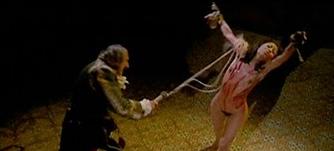
Despite the exploitation trapping, the fake spiders, and the Gothic overtones, Nude for Satan attempts to be an exploration into the depths of the human soul and psyche. Now it does it with an equal precision of The Devil in Miss Jones (1973) while trying to play like it's Ken Russell's The Devils, but it's armchair metaphysics are the glue that hold the film together. Well, that and an overabundance of boobs. Ladies will not find that the favor is reciprocated, and even when it is I can't imagine Stelio Candelli or James Harris being any one's idea of beefcake. In the end, whatever meaning Batzella might have been trying to shoehorn into his film was far overshadowed by the fact that it ends with a 10 minute slow motion lesbian makeup session which only gets weirder when The Devil summons a couple of NFL super fans in thongs to join the party. There is something a bit Rocky Horror about the whole film, as giving yourself over to absolute pleasure seems to be the name of the game. It also follows a couple of innocents as they delve into sexual perversion that culminates in a floor show. If only Satan's creepy butler had rebelled, we'd really have something.

None of the actors really stand out though Stelio Candelli does do an excellent job grounding the film. Rita Calderoni does a smashing job being nude throughout, and she has a few scenes that really work. James Harris, who had a brief and undistinguished career, is quite menacing as the man from the pits of Hades, and he really steals most of the movie away from the main menaced couple. Renato Lupi made for a great Devil's butler, and he reminded me a bit of Roland Topor in Werner Herzog's Nosferatu the Vampyre. Cinematographer Antonio Maccoppi had clearly been influenced by the early work of Mario Bava, and the sets are awash with colored gels. Nude for Satan also features a swinging score to go along with its literal swinging, and Alberto Baldan Bembo would go on to score the films The Gestapo's Last Orgy and Black Deep Throat (surprisingly not a porno, bu an exploitation film about an investigative reporter uncovering a cult.)

Nude for Satan is really a film that will only interest Italian movie junkies, exploitation hounds, or people for which being nude for Satan sounds enticing. While I found the film interesting and I found it hard to look away lest I miss something absurd, I highly doubt there's any re-watchability here. I can't see me on a weekend afternoon popping in Nude for Satan for a few laughs. However, if you're like me and you love to see what those nutty Italians put in their films, then this is a can't miss rental. Running at a light 87 minutes, Nude for Satan doesn't have time to mess about. It's got to get these people naked and start into messing with their minds and their bodies. If an idle mind is the devil's playground, then this idle film must be like an amusement park.

Bugg Rating 

Joysticks (1983): Greydon Clark Gets Next

As the road to Horrorhound Weekend draws me ever closer too my destination, I am still scrambling to catch up on the work of many of the guests. Today I want to talk about a very special attendee, Graydon Clark, who is being brought in by the fine folks at Cashiers du Cinemart, the magazine and online cult film resource which has so often championed Clark’s Black Shampoo as one of the best films of all time. While I can’t go that far for Black Shampoo (I do love it though and can’t wait to have my classic clamshell case signed.), I’ve always been a fan of Graydon’s work no matter if you’re talking about his acting in films like 1969’s Satan’s Sadists or his direction of flicks like Satan’s Cheerleaders or The Return. However there’s so many I haven’t had time to see. One such, the rare Without Warning, I will finally get to see at HHW with Mr. Clark in attendance, but one I’ve had sitting around the house for ages without getting to it, the 1983 Arcade-sploitation flick, Joysticks.

If you ask Joseph Rutter (top billed Joe Don Baker) they’ve got trouble, oh they’ve got trouble, right here in River City! Trouble with a capital "T" that rhymes with "V" and stands for Video Games. With Jefferson Bailey (Scott McGinnis) left in charge of the Video Arcade while his grandfather, the owner, is out of town, it’s become more popular than ever. All the River City teens; boy and girls, punks and nerds, and jocks and dweebs, are spending too much time in the arcade. This includes Mr. Rutter’s valley girl daughter, Patsy (Corrine Bohrer), who has begun to hang out in the Arcade (with the dreamy Jefferson Bailey) rather than go down to The Galleria. So Rutter, and his dim-wit nephews, try and put the arcade out of business, but their plans continue to backfire. It finally comes down to a test of skill, as Rutter employs punker King Vidiot (John Gris) to challenge Jefferson’s best player, Class President turned fat slob McDorfus (Jim Greenleaf) to a game of Super Pac-Man with the fate of the Arcade on the line.

In an interview with Mondo Video.com, Greydon Clark remembered the inspiration for Joysticks coming to him, “I was in San Antonio, Texas attending a “sneak preview” of  Wacko when the idea for Joysticks came to me. I saw a group of young people standing in line to play a video arcade game in the lobby of the theatre.  It was the first video arcade game I’d seen and I realized I could create a movie based around an arcade.  Most of my movies come from an idea that somehow snuck into my consciousness.” When Mr. Clark was beginning to make his film I was seven years old, and video games were very much a part of my consciousness. From games tucked into the corner of every convenience store and restaurant to the roller skating rink and the dim, smoky (yes, smoky) confines of my local Aladdin’s Castle, I was constantly on the search for a game to play. I wasn’t the only one. Only a year before “Pac Man Fever” had become a hit song and bookstores were crammed with guides on how to play and win at your favorite arcade games. Atari’s were a must have in all my friend’s homes, and so enraptured were we that the thought Nintendo would change everything only three years later was outrageous.

So with the country in such an upswing of video game fever, I’m surprised there weren’t more movies like Joysticks that took advantage of the latest craze. While there have been some since (The Wizard for example) or tangentially related (Cloak and Dagger), I can’t think of a single other title that found its inspiration in the Arcade. Another thing that surprised me is that I couldn’t Google up an instance where a real Arcade in the ‘80’s (or any other time) was protested. I feel certain it had to happen, but then again I may be looking at that through a modern lens where everything is quickly protestable. Actually, when I was trying to find something I searched every variation of “Video Game Arcade Protest”, and all that would stubbornly come up is a “video” from “Arcade Fire” about the Wisconsin “Protest”. (On a side note I would like to “Protest” anything having to do with “Arcade Fire”, but I digress.) When you get down to brass tacks, Joysticks is an ‘80’s “Save the…” film. Save the what? What’cha’ got? While usually the place in question is a Community or Rec Center, it could just as easily be a ski lodge, a sports program, or, yes, an arcade.

Joe Don Baker, who landed top billing as the protective father turned anti-video game crusader, hams it up effectively, clearly relishing his bad guy part. This was Joe Don’s second Greydon Clark film as well as his co-star, Scott McGinnis, both appeared in Wacko. McGinnis is enjoyable enough, but I didn’t find his preppy manager all that likable. The real stars are the weirdos, nerds, and punks. John Gris, who is best known now for his role as Uncle Rico in Napoleon Dynamite, takes over the film every time his punk rocker King Vidiot shows up. No matter if his Highness is riding his new wheels (a mini-bike) dancing around with his all female troupe of Vidiots, or trying to seduce one of  Rutter’s nephews in drag (long story) only to grab his junk and howl in pain when rejected, Gris is simply too much fun to watch.  Leif Green (whose biggest claim to fame is a role in Grease 2) entertains as Eugene, McGinnis’ nerd employee, and Jim Greenleaf, who shines as the arcade’s house champion and slob, might be recognized by the keen-eyed horror fan as Ox from the Clint Howard masterpiece Evilspeak.

Now I haven’t talked a whole lot about the film making itself, but let’s be honest, while Greydon has done some of the best and most original exploitation titles over the years, it’s hard to claim that the look of Joysticks is above average. His ideas, the entertainment value of his films, and the actors he chooses far outclass most cult films which is why so many of us love Greydon, but there’s little chance a viewer would walk away stunned by the visuals. However, when you think about his miniscule budget, and then weigh that against the settings and situations in the film, it’s clear he knows how to make a dollar look like two dollars. My point is this, watch Fellini for Fellini and watch Greydon Clark for Greydon Clark. If you want to have fun and watch a crazy film then check out anything Mr. Clark has to offer, you can’t go wrong, but if you want high art, then there’s plenty of that to be found elsewhere.

Probably my favorite moment in Joysticks comes when Joe Don’s Joseph Rutter drags Jefferson and crew in front of the town council in order to get the arcade closed down. This presentation includes a stern warning from a nurse that arcade games could cause “callus between the thumb and forefinger” and “Pac-Man Arthritis” not to mention the “germs all over the joysticks”. This, coupled with the football coach’s claim that “Video Games are worse than dope, booze, or women.”, reminded me so much of the outrageous claims about marijuana and in films like Reefer Madness and The Burning Question. This thread of classic original exploitation brought though fifty years of cult film and landing smack dab in the middle of Joysticks is one of my favorite things about the film. Greydon Clark is a name that’s been a mainstay in cult film since the 1960’s, but his films always continue the spirit of cult and exploitation film, from where they began to where they will go. (Is there any question Black Dynamite owes something to Black Shampoo?) Joysticks is another great example of this, and a title that any lover of off beat cinema should add to their “must watch” pile. After Horrorhound, I’m sure to have some thought about Without Warning to share with you, but until then let me put a quarter up ‘cause I got next play.

Bugg Rating