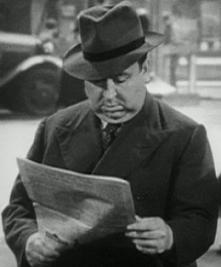
The word correspondent, much less the term Foreign Correspondent, holds little meaning in today’s world of twenty four hour news populated by an endless procession of talking heads. At one time, these correspondents were American news’ only link to what was happening overseas, and their hastily delivered telegrams and missives shaped public opinion of everything from religion to the growing threat of war. One such correspondent was Vincent Sheean, a journalist for the Chicago Tribune in the 1920’s, he often found himself right in the middle of the rebel factions, civil wars, and political unrest which plagued Europe between the two World Wars. It wasn’t so much luck as Sheean’s determination to get the story. In 1933, Sheean began to write a biography of sorts, Personal History, which recounted his exploits over the last eleven years in Europe, and most importantly, the threat of the rising fascists set to take over the continent. Published in 1935, Sheean’s book caught the interest of producer William Wagner, but after years of trying to cull a successful screenplay from the book, he had only one hope left, a newly immigrated director from England on loan from David O. Selznick, Alfred Hitchcock.
Vincent Sheean
In Personal History’s long road to the Master of Suspense’s hands, it had been run through the gauntlet of Hollywood screen writers. Looking over a few of the uncredited names that worked on the film at one time or another, writers like John Howard Lawson (Bogart’s Sahara), John Lee Mahim (The Bad Seed), Richard Maibaum (13 James Bond films), and future Hitchcock collaborator Ben Hecht spring out. The final credit for the film adaptation given the moniker Foreign Correspondent went to Charles Bennett, who had already penned The Man Who Knew Too Much (1934), The 39 Steps, and three other Hitchcock films (though this would be his last) and Joan Harrison. Her career as a screenwriter has much to do with Hitchcock’s transition from the British to the American audience beginning with 1940’s Rebecca, and her contribution to Hitch’s career from screenwriting to her position as the producer for Alfred Hitchcock presents. However, if we get into talking about Joan Harrison we’ll be here all day. So expect to be here all day when I finally get around to covering Rebecca. As if that were not enough for the writing credits, Hitchcock also employed writer/actor/humorist Robert Benchley and novelist James Hilton (Goodbye Mr. Chips) to punch up the dialog.
Foreign Correspondent kicks off with New York Globe editor Mr. Powers (Harry Davenport) cursing the ineffectiveness of his man in Europe to dig up a story. He decides that he needs a new kind of reporter on the job, and John Jones (Joel McCrea), who recently punched out a cop to get at a story, is just the kind of reporter he needs. Renaming Jones with the more dramatically journalistic name Huntley Haverstock, he ships the no nonsense American to England for a meeting between Universal Peace Party leader Stephen Fisher (Herbert Marshall) and Dutch diplomat and peace activist Van Meer. Jones smells a story, and soon he is dashing across the continent to follow the action to Amsterdam. There Van Meer is assassinated, but when Jones discovers the diplomat very much alive and being held in a deserted windmill, he only begins to understand the vast conspiracy unfolding around him. To complicate matters, he begins to suspect that Fisher is involved, and Jones has developed feelings of the Peace Party leader’s daughter Carol (Laraine Day).
While Rebecca was Hitchcock’s first film in America, Foreign Correspondent was his first experience with being caught up in the studio system. David O. Selznick who had just lured the director to his studio was just as quick to show Hitchcock who was in charge. Rebecca had been a commercial and critical success, but Selznick didn’t want Hitchcock to get out of hand. So he loaned him out to independent producer William Wagner who capitalized by finally bringing his languishing property to the screen, but Hitchcock received no extra dispensation from his contract or his compensation. He also found himself at a disadvantage being unable to land any of the stars he wanted for his film. For the part of the dashing reporter, he wanted Gary Cooper, but starring in a thriller, then regarded as less desirable pictures, was not something the actor was willing to do though in later years, he would tell Hitchcock personally that he regretted that decision. Barbara Stanwyck, Hitch's choice for the female lead, turned out to be unavailable because of the shooting schedule for Frank Capra’s Meet John Doe where she starred opposite Gary Cooper.
In their place Hitchcock instead got Laraine Day and Joel McCrea. Day, best known at the time for her role as Nurse Lamont in the Doctor Kildare films, lobbied hard to get the part, and after Hitchcock viewed a few of her films he agreed to meet her. The director took a liking to the actress and hesitantly cast her in the role of Carol. Joel McCrea, however, who Hitchcock referred to as “a second class Cooper” had an uneasy relationship with the director throughout filming. Hitchcock thought the actor “too easygoing”, and made no effort to disguise his boredom with McCrea. For his part, the actor often told tales of how the director would doze through whole takes and had to be prompted to call “cut”. However, these stories went unverified beyond McCrea’s complaints. Hitchcock was not an actor’s director to begin with, but he seemed to have a specific displeasure of the two leads commenting later to Francois Truffaut, “I would have liked bigger star names.” That being said, I found McCrea to be full of American brashness and charm while Day was the run of the mill one for me. Uncharacteristically for a Hitchcock film, while Day has some emotional heft included in her role, she fits none of the normal notions of a Hitchcock leading lady.
There are also a good number of supporting performances that make Foreign Correspondent a well rounded and interesting film. Herbert Marshall, who starred in Hitchcock’s 1930 film Murder, impresses as incriminated Peace Party leader. Incidentally, Marshall only had one leg, having lost one in World War I, and special arrangements had to be made for her part in the film’s climatic scenes. George Sanders, who also appeared in Rebecca, is delightful as Jones’ British counterpart ffolliott (the lower case double ‘ff’ is a trait I’ve only seen in ffolks). He also struck me as looking like a cross between Jason Segal and Stephen Frye, but that is neither here nor there. Robert Benchley shows up as Stebbins, a comic relief character for which Benchley wrote all his own lines, and seeing as it’s Christmas I should note the appearance of Edmund Gwynn. While Gwynn is best known as playing Santa in Miracle on 34th Street, here he appears as a hitman who tries to push Jones off the top of Westminster Abby. He would work with Hitchcock again fifteen years later when he starred in the comedy The Trouble with Harry.
Instead of his actors, Hitchcock seemed to throw himself into inventive visual techniques to achieve some of the film’s most stunning sequences. My favorite was the windmill scene where John Jones creeps around a windmill while trying to avoid several groups of bad guys. There’s a great claustrophobic feeling to the scenes, and it is cleverly shot with Jones moving just around of above the assassins’ line of sight. This sequence also features a sly visual reminder when Hitchcock inserted a picture of Adolf Hitler tucked into the scene to remind pre-World War II audiences who the real villain was. The second sequence was an airplane crash complete with flooded cockpit. With clever use of rear projection, a dummy cockpit, and a large tank of water, Hitch managed to shoot the sequence in one shot with no cuts. While it may look rudimentary now, it was just the type of groundbreaking special effects sequence Hitchcock pioneered in so many of his films. Throughout the film the consistent use of interesting angles, thanks to Hitchcock and Polish cinematographer Rudolph Mate, keeps a good balance between the snappy dialog and the deadly serious subject matter. The only portion of the film which comes up short is the score by Alfred Newman (Camelot, How the West Was Won). When I saw his name, I assumed there would be no worries, but the Foreign Correspondent’s score is not bad as much as spectacularly unmemorable.
In many ways Foreign Correspondent was a political film. The ending, a tacked on radio broadcast that predicted those Walter Winchell would broadcast from Britain during the Blitz, was a call to arms. It was intended to rally Americans to the side of their British friends. Just like John Jones had done his part to help the war effort, so must America. The ending, while wrapped up in jingoistic trappings, is inspiring, and eerily prescient. While Jones pleads for American’s involvement, London is being bombed, and that is just what was happening beginning three days before the film’s release. It would still be another year before America would actually be pulled into the World War. For all Hitchcock’s protestations at both the cast and the material, I can’t help feeling that he knew just what he intended to do with his film. Just as John Jones was reporting the dangers of Europe, so was Hitchcock. He saw the specter of war, far more frightening than anything in his lurid imagination, and hoped that his new home in America would come to the aid of his native soil.
Following the release of 1943’s Shadow of a Doubt, Alfred Hitchcock was swept up into the events of World War II as pretty much everyone else was. He laid his sites on providing moral support to the French resistance with two short propaganda films, Von Voyage and Aventure malgache, but the contract that had brought him to America called, and Hitch was forced by studio head David O. Selznik to make a film for Fox studio. He had an idea in mind about a group of people trying to survive at sea. First he approached writer Earnest Hemingway to be the author of the tale, but Hemingway was otherwise engaged.
Wanting a writer who had a connection to the ocean Hitchcock turned to Old Man and the Sea scribe John Steinbeck. Hitchcock provided Steinbeck with the scenario, and the author was quite interested. Within a week, Steinbeck returned with a 100 page novelette featuring one character trapped on a boat with only his inner monolog to keep him company. Needless to say, it was not what Hitch was looking for. American novelist MacKinley Kantor took a crack at it next, but struck out after only two weeks. Next, the director brought in Frank Capra’s screenwriter Jo Swerling, and the final draft was penned by Swerling, Alma Hitchcock, producer Kenneth MacGowen, and the director himself. Hitchcock said he was looking to give the film. “a dramatic form to each of the sequences.”
The script of many authors was entitled Lifeboat, and it would become one of Hitchcock’s most unusual films An American ship gets torpedoed by a German submarine, and a small band of survivors makes their way onto a lifeboat. They include war journalist Constance Porter (Tallulah Bankhead), hardened sailor Korvac (John Hodiak), the brainy merchant marine Sparks (Hugh Cronyn), young nurse Alice (Mary Anderson), shipping magnate Charles Rittenhouse (Henry Hull), wounded soldier Gus (William Bendix), and ship porter Joe (Canada Lee). The German sub was also sunk, and they soon fish a German survivor, Wily (Walter Slezak) out of the water. Adrift in the middle of nowhere, they try desperately to make it to land, but they must contend with a shortage of rations, a leg gone to gangrene, exhaustion, and the sly plotting of their German captive.
The entirety of the film is set on the small boat, and going into this film, I wondered if it would keep my attention, and let me tell you, it sure did. Lifeboat does not rely on anything flashy to make the film engaging; instead it relied on a batch of really incredible performances from a great cast. Each of the characters gets some degree of development, and the microcosm comes alive in these performances. Hitchcock said he wanted the group to show that, “there were two world forces confronting each other, the democracies and the Nazis, and while the democracies were completely disorganized, the Nazis were clearly headed in the same direction. So here was a statement telling the democracies to put their differences aside temporarily and to gather their forces to concentrate on the common enemy, whose strength was precisely derived from a spirit of unity and of determination.” This comes to light clearly as the survivors bicker and backbite as the Nazi waits and plots patiently to lead them astray. Finally he even manages to turn the tables on the divided group, and only when they finally combine efforts could they overcome the common enemy.
All of this could have faltered on the screen if it were not for the terrific cast, and their performances. I’m going to start off with the female lead in the film, and the titular lifeboat’s first passenger, Tallulah Bankhead. Ms. Bankhead had a middling motion picture career, but Hitch was determined the actress who was often prone to scandalous quotes was the right one for the role. The outspoken actress was perfect for the role of the cynical journalist, and Hitchcock stated that “the characterization by Tallulah Bankhead dominated the film.” I’m not so sure it dominated, but her character arc from cold cynic to sexual seductress to last ditch idealism is one of the best female performances I’ve seen in a Hitchcock film.
John Hodiak as the tattooed, hard ass sailor comes off a bit like a rougher version of Gable, and I really enjoyed watching him take faltering command of the lifeboat’s “crew”. Hugh Cronyn, in his second Hitchcock film, proves why his career will stretch on for decades, and his romance with Mary Anderson’s young nurse is underplayed and very, very sweet. Henry Hull, who horror fans may know from his lead role in Werewolf of London, mugs and swaggers through his role as the eccentric millionaire, and Canada Lee does what he can as Joe the porter, a role that sadly reflects the marginalizing and institutionalizes racism still so inherent in the time period.
There are two other performances that really stand out, and their stories are perhaps the most entertained of any on the tiny craft. William Bendix gives an alternately humorous and touching performance as Gus Smith, who has changed his last name from Schmidt. Gus’ leg is full of shrapnel when he boards the boat, and when it must be taken care of it falls into the hands of Wily, the German soldier, to remove the leg. Gus survives the removal, but later as he pined away for the girl he left back home who loved to dance, I could not help but pity him. Ultimately, Gus Schmidt’s fate lies at the feet of Wily, and Walter Slezak does a hell of a job. Slezak gave the Nazi all the reserved menace the role required. I don’t think it’s a spoiler to say that I saw his double cross coming from the moment he stepped on the ship, after all, it was 1944 and the war was at a fevered pitch. There was no way there would be a film with a nice Nazi in it released on American soil.
Hitchcock’s films usually make dramatic use of the score, but Lifeboat wisely does not contain one. I really liked that the scenes occurred with only the sounds of the water splashing against the boat or with the occasional song emanating from Canada Lee’s flute. For Lifeboat, Hitchcock chose to work with cinematographer Glen MacWilliams who he had last collaborated with 10 years earlier on the 1934 Strauss bio-pic Waltzes from Vienna. Hitchcock and MacWilliams did a wonderful job making the giant tank of water on the Fox back lot look like an endless ocean. The film also garner’s suspense through clever use of camera angles to cheat events to or away from the audiences’ view. The camera never seems to leave the tight confines of the ship, and it gives the production a wonderfully claustrophobic feeling.
Lifeboat may not be everyone’s cup of tea. Some may find the tight quarters to be rather dull, but I think if you value strong performances, that you will find yourself well pleased with this film. It is also a very interesting political statement from a filmmaker who usually was more compelled to make films about the internal struggles in life. With Lifeboat, Hitchcock explored that, in a time of war, man’s inner struggles had to be put aside to beat back the tide of evil that was invading the world.
Bugg Rating
There's no Trailer for this film, but here is a great little cut of an early scene in the film.
When Memorial Day was established, it was first intended to be a day to remember the dead soldiers of the Union army, but after World War I it was repurposed to be a day of remembrance for any of war’s fallen dead. With this in mind I chose a film about a man who never forgot his fellow soldier, so today I’m talking about a fellow called Braddock and a film called…
Missing in Action (1984) starring Chuck Norris, M. Emmett Walsh, James Hong, and Ernie Ortega. Directed by Joseph Zito.
Col. James Braddock (Norris) had only recently escaped a Vietnamese prison where he had been held for many years, and now he’s on a mission to save other Americans held hostage. However, the Vietnamese government, through spokesman Gen. Trau (Hong) denies that there are any such prisoners. Enlisting the help of former army buddy Tucker (Walsh), Braddock makes his way deep into the jungles of Vietnam to bring back any men he can find that have been missing all these years.
The Bugg Speaks
After the success of First Blood (1982), all the studios were looking for a film to capture the same zeitgeist as the first tale of John Rambo. So who better to call in than one of the most jingoistic of action stars, Mr. Chuck Norris, and while Chuck’s film did not have the impact of Stallone’s, it did lead to two more sequels and plenty more chances for Norris to show off his beard. Unlike First Blood’s portrait of a PTSD nightmare, Missing in Action portrays Norris’ Braddock as troubled, but strong enough to overcome it. He’s also strong enough to kick anyone’s ass who gets in his way and magical enough to pull off some incredible feats of daring. In some ways, one might wonder if Missing in Action influenced the broader action in 1985’s Rambo: First Blood Part II.
As is usual, Norris plays the tough guy to the hilt, but unlike his earlier films, Missing in Action downplays his martial arts prowess for gunplay and enough explosions to make Michael Bay jealous. Braddock seems to mope about most of the time if he doesn’t have a gun in his hand, but he does show a few lighter moments that saved the story from getting monotonous. He also likes to change his shirt, and I do mean a lot. When I mentioned this to my wife, she informed me that women used to quite like Chuck, but I found it hard to believe that many women swooned over a man with that much orange hair on his body. At any rate Norris goes though at least a half dozen onscreen costume changes which, in its own rite, becomes quite funny after a bit.
Missing In Action also features a few of my favorite character actors. Gen. Trau is played by James Hong who has long been a fixture in Hollywood films anytime there’s a call for a thin, creepy Asian actor, but many may know him best as the diabolical David Lo Pan in the classic Big Trouble in Little China. Then you have M. Emmett Walsh, the reliable character actor that I consider something of a spiritual brother to Joe Don Baker. Walsh may be best known for his work in Blade Runner or as the sniper out to get Steve Martin in The Jerk. In Missing in Action he provides some comic relief as Braddock’s army buddy, and he is a welcome relief from Norris’ increasingly serious tone as the film goes on.
The film starts rather slow with over an hour devoted to setting up both Braddock’s character and the conflict with the Vietnamese, but once you get past that point the film kicks into high octane mode and it revels in explosions and gun battles that get pretty exciting and ludicrous. My favorite bit of action silliness has to be when the baddies think they have killed Braddock in a river, and he rises (in slow motion of course) from the water while firing his M-16 for all that it’s worth. It’s the perfect example of the excess of the ‘80’s action hero. Not only is it unbelievable, the way it’s played out is reminiscent of how one might film a bikini clad goddess rising from the water.
This is a film with a serious message, and I for one would never make light of the plight of any soldiers who are missing or imprisoned in a foreign land. The problem is how seriously can you take a message when the film is adorned with stereotypically bad Vietnamese, pyrotechnics for the sake of spectacle, and a man who changes his shirt so often you’re not sure if he’s a clothes horse or just get’s that smelly that fast? I have yet to see the sequels, but my wife who has tells me that they just get more over the top and ludicrous as the story goes on which hardly seems possible. Missing in Action does not rank up there with the greats of ‘80’s action cinema, and it seems to me that by this time Norris had already left the best of his work behind him. It’s not a bad film, but if you’re going to remember the soldiers, at least give them something great to be remembered by.
Quentin Tarantino has made some of the greatest films this Bug has ever seen. Reservoir Dogs is a modern classic, Pulp Fiction changed cinema forever, Jackie Brown (my personal fave) brought back Pam Grier and was the best interpretation of Elmore Lenoard's work, From Dusk til Dawn was a great vampire thrill ride, and the Kill Bill movies paid homage to martial arts flicks and revenge movies in a whole new way. At this point he's earned his wings to do whatever he wants to do, and what he wants to do is go back to the homage barrel and pull out today's film. It'll probably be great, and the Bug will be flying down from the moon as fast as I can to see it. Sometimes though (often really if you look at the track record on remakes.) its better to leave well enough alone and let the original stand on its own.
Inglorious Bastards (1977) starring Bo Stevenson, Fred Williamson, Peter Hooten, Jackie Basehart, and Michael Pergolani. Directed by Enzo G. Castellari.
The movie opens in 1944 with a group of military prisoner being loaded up to be tried and sentenced, but on its way its attacked and the prisoners escape from both the German air strike and the guards who are shooting at them. We meet Tony (Hooten) a formally mobbed up Chicagoan, Nick (Pergolani) a klepto and forger, Burl (Basehart) a deserter, Fred (Fred Williamson of Black Cesar fame), and Lt. Yeager (Bo Stevenson, best known at the time for being in the Walking Tall sequels). They team up and escape with a plan to make for the Swiss border and get out of the war and away from their fates.
They find shelter in a barn, and while there find a German deserter, Adolf, in the hayloft. Seems he's tired of the war as well and all the Germans getting killed, and he agrees with a little convincing from Fred and his machine gun, Baby, to be their guide. So naturally what happens, they immediately get captured by a German convoy which they only manage to escape because the Allies start bombing it. They steal a German truck and get on their way. The next scene is a nice distraction as it features naked chicks with machine guns, but then they finally find some safety in a cave. All is well until a group of Germans come to check out their truck. They send Adolf out to talk to them and smooth things over, and when he turns around and cries "Americans, Americans" they think they've been ratted out. They don't seem to notice the Germans gunning him down. The Bastards mow down the Germans only to get surrounded by members of the French resistance. Seems the troops they just killed were a American strike force who were traveling incognito as Germans to hook up with the French for a mission. The French assume the Bastards are the team and take them back to their base.
The guys get some time to relax in camp as they away the arrival of Corneal Buckner who is in charge of the mission. There's a couple of good scenes here with Tony and Fred, and one where Nick tries to sell some merchandise to the French, but finds the only English they speak is the dirty words. Funny that's the only French I speak. Eventually, Buckner arrives and finds his team is not there, but the Bastards instead. Yeager tries to make a deal with him to do the mission in trade for their freedom, but he refuses so they take him captive and leave the camp. Once they leave, they decide they need some wheels and go to a German SS base to try and get a car. The Germans say they will give them a car, but they take their prisoners, Buckner and Fred. The Bastards leap into action and spring their two friends in a very entertaining action sequence. Buckner is so grateful he offers the Bastards the mission which is to board a train and disarm a new kind of missile that the Germans have been developing.
All the train action scenes as Yeager and Buckner pose as German rocket scientists are great. The other Bastards all have their own jobs and their scenes are great as well. I have to especially point out Nick who is kind of played like a Italian Harpo Marx as having the best part of the climactic part of the flick. It's a great end with tons of gun battles, explosions, and fistfights that all leads to a satisfying and awesome climax.
Inglorious Bastards plays to the best in the vein of The Dirty Dozen and Von Ryan's Express mixed with some of the humor evident in the lighter moments of Clint Eastwood's Man with No Name movies. Its evident throughout why Quentin loved and was influenced by this film. From the snappy dialog to the action goodness, it's right up his alley. However, its such a great film in the genre that its hard for me to think a remake would be better. From what I understand QT's version is not going to be a direct remake but taking bit and pieces from it and all the other war films bouncing around in his head. Personally, I can't recommend this movie enough, and I urge anyone who thinks they'll be going to see the new version to check this out in advance. It has recently been released in a shiny new 2 disk version that includes a conversation between QT and Bastard's director Castellari. Watching QT talk about movies always makes me tired though and even thinking about it is making me tired right now. So check it out moonies tell them the Bug sent you.

 The word correspondent, much less the term Foreign Correspondent, holds little meaning in today’s world of twenty four hour news populated by an endless procession of talking heads. At one time, these correspondents were American news’ only link to what was happening overseas, and their hastily delivered telegrams and missives shaped public opinion of everything from religion to the growing threat of war. One such correspondent was Vincent Sheean, a journalist for the Chicago Tribune in the 1920’s, he often found himself right in the middle of the rebel factions, civil wars, and political unrest which plagued Europe between the two World Wars. It wasn’t so much luck as Sheean’s determination to get the story. In 1933, Sheean began to write a biography of sorts, Personal History, which recounted his exploits over the last eleven years in Europe, and most importantly, the threat of the rising fascists set to take over the continent. Published in 1935, Sheean’s book caught the interest of producer William Wagner, but after years of trying to cull a successful screenplay from the book, he had only one hope left, a newly immigrated director from England on loan from David O. Selznick, Alfred Hitchcock.


